

AI's Better Angels
The particular loves that shape a powerful set of tools
By Alex Arnold
The dramatis personae in Josh Tyrangiel’s book AI for Good: How Real People Are Using Artificial Intelligence to Fix Things That Matter (Simon & Schuster, 2026) don’t really care that much about AI per se. For example, Tomislav Mihaljevic, CEO of the Cleveland Clinic, disclaims any interest in becoming the leader of an AI company. “People come to the Cleveland Clinic because they need treatment for complex conditions…That is our reason to exist.” Such an attitude toward AI generalizes across the characters profiled in Tyrangiel’s book: They care much more about other things. They have taken up AI only because it might help them better preserve and care for what they love.
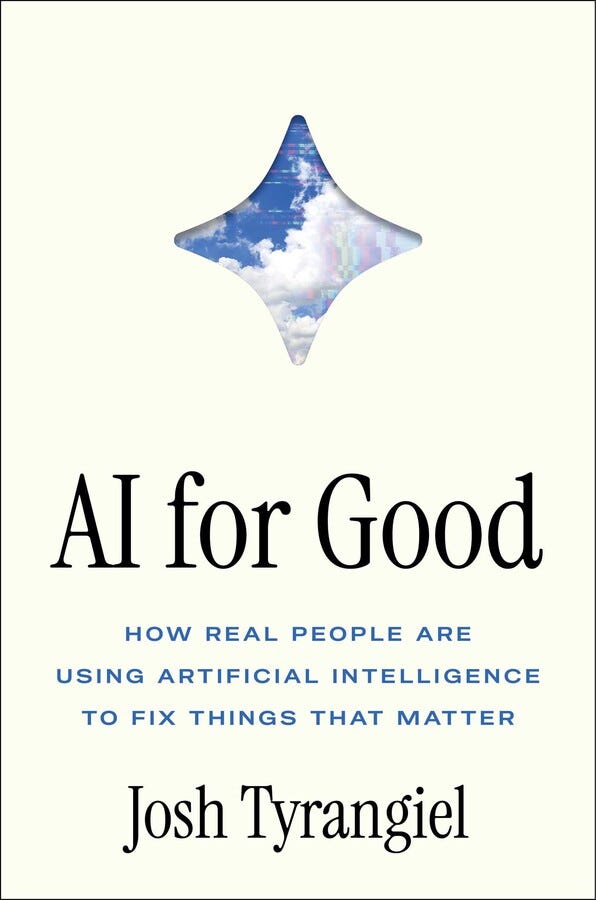
Tyrangiel’s method in the book is neither analytic nor argumentative. He does not lay out an abstract, systematic theory of what makes for good AI. Instead, he tells stories about people using AI for good. The stories are arranged in four parts, each covering a different domain. The first part focuses on the uneven, halting rollout of Khan Academy’s AI-powered tutor chatbot Khanmigo. The reader comes away suspecting that AI, while it may help improve education, is no silver bullet. The second part narrates Tyrangiel’s engagements with doctors, nurses, and management at the Cleveland Clinic, who are developing and deploying machine-learning systems to improve cardiac imaging, transcribe patient conversations, and flag warning signs of sepsis (among other things). In the third part, Tyrangiel examines attempts to use AI for good in government, moving between Brigadier General Gus Perna’s collaboration with Palantir to manage the COVID-19 vaccine supply chain, a laborious effort to modernize the IRS, and a local recycling program that used computer vision to reduce contamination; this part also contains a digression on the vagaries of DOGE’s reform attempts. In the last part, Tyrangiel tells the story of Kristy Johnson, a scientist whose son Felix has an extremely rare genetic condition that leaves him nonverbal; she endeavors to use AI to help her son communicate and be understood.
Johnson’s story I have meditated upon the most. There is no amazing, miraculous deployment of AI involved. Rather, it is a story of a mother’s deep love for her son, a steadfast love that drives her to devote her days to interpreting his peculiar vocalizations and crafting tools that might one day enable him to be heard and understood by others. The AI-powered technologies serve her desire to better love her son, and it is such love that shapes the AI into something for good.
The pattern exhibited by Johnson holds true across most people appearing in AI for Good. They are people with concrete problems in search of concrete solutions, and AI strikes them as possibly helpful. In Tyrangiel’s words, they have “chosen the divine, ridiculous task of trying to fix what they love, using a technology they’re only beginning to understand.” Whether he means anything special by calling the task “divine,” I cannot say, but Tyrangiel is unusually attuned to the religious dimension of his subjects: He mentions Debbie Kwon’s Christian faith, notes an Indiana school superintendent’s cross necklace, and discusses MIT professor Rosalind Picard’s faith at some length. Whatever Tyrangiel’s attitudes toward religion might be, however, he depicts the people in AI for Good as making AI “a collaborator in the effort to preserve and improve the things [they] love” (p. 11)—a divine work indeed.
Tyrangiel’s survey of beneficial applications of AI is simultaneously a survey of what emerges when people with concrete cares discover a powerful new tool. Kristy Johnson’s love for her son informs every choice she makes in tinkering with various machine-learning technologies. Debbie Kwon and her collaborators at the Cleveland Clinic are committed to their calling as doctors; the purpose of that calling—to heal the sick—motivates them to explore better ways to do cardiac imaging. Sal Khan’s passion for educating students sustained him for decades in creating Khan Academy; it also disciplined him and his team in designing the chatbot Khanmigo, to ensure that it didn’t devolve into a sycophantic companion. In the cases Tyrangiel describes, the loves of the people involved are a major part of what makes AI for good.
The loves that prompt AI for good in Tyrangiel’s telling are fairly concrete. Contrast their concreteness with the impressionistic and abstract loves that appear in a lot of AI discourse—things like intelligence that is too cheap to meter, the automation of all human work, a “post-scarcity” future, even the “acceleration” of history itself. Because they are so abstract, such loves impose little discipline—unlike love of one’s son, or one’s vocation as a doctor, or one’s countrymen suffering from a pandemic.
The parable of the Good Samaritan illustrates why the contrast matters. When a clever lawyer asks Jesus who his neighbor is—he is trying to “justify himself,” a temptation I have oft succumbed to in the philosophy seminar room—Jesus tells the story of a man brutalized by robbers, passed over by a priest and a Levite, and rescued finally by a Samaritan, who bandages the man’s wounds, brings him to an inn, and lavishes coin on his convalescence. After telling the parable, Jesus flips the lawyer’s question. He does not ask which of the three counts as the wounded man’s neighbor. He asks which of the three showed himself a neighbor to the man. The lawyer answers, “The one who showed him mercy.” Jesus responds, “Go, and do likewise” (Luke 10:37, ESV).
Read through the parable, Tyrangiel’s stories highlight that love of neighbor is fundamentally proved in deed, by “showing mercy” to particular people in their weakness. Love of neighbor is not mere sentiment, nor is it generic benevolence toward Humanity-in-General. It is concrete action, sometimes sacrificing much, for the sake of another in need. We might interpret the characters in AI for Good not just as highly motivated, technologically savvy problem solvers, but also as good Samaritans with a powerful new tool in their traveling bags, with which they intend to show mercy.
Kristy Johnson does not ask the general question of how AI can help autistic children; instead, she asks how she can better love her son. Gus Perna comes out of retirement to serve his suffering country by spearheading the unglamorous task of hacking together a system to track the COVID-19 vaccine supply chain. The Cleveland Clinic doctors do not aim at building an AI-powered empire of medicine; they ask how they can better serve the ailing in their care. Sal Khan does not ask how AI can solve all of education’s woes; he rather asks how Khan Academy can better serve the particular schools it works with, and the particular students it teaches. In each case, the question begins with the needs of one’s neighbors and works outward toward what showing mercy might now look like.
Some Christians are already working to fill out what the Good Samaritan mode of AI for good might look like. The Praxis venture-building network’s “redemptive AI” thesis argues for AI that fosters personal relationships rather than replacing them and that redounds to the prosperity of the poor, not just the rich. The general upshot of the redemptive thesis is correct: The Good Samaritan’s AI for good is given for the sake of one’s neighbors, not in pursuit of mere profit or vague, abstract, and grandiose visions of the future.
The parable also highlights that, just as the Good Samaritan needed the innkeeper to provide shelter and care, so too do good Samaritans using AI need help beyond themselves. Kristy Johnson needed research funding, institutional collaborators, and institutional permission and support. Gus Perna needed the authority and trust (or at least non-interference) of higher ups to make big gambles. Debbie Kwon needed the buy-in of hospital executives with access to large capital budgets. Sal Khan needed philanthropic backing and the trustworthiness of a platform built over decades. Unless one has the power of creatio ex nihilo, all the love and mercy in the world will only get one so far. Kwon herself notes that “culture, alignment, people” (p. 145) tend to be the hard part—and these are all matters of the quality of institutions.
For some civic leaders inclined to treat the issues that AI raises as matters of incentives, institutional design, and regulation, and for others inclined to treat AI as primarily a matter of character, desire, and motives, the lesson of AI for Good is that both institutions and the loves of individuals deserve our attention: Tyrangiel’s stories suggest that both jointly shape what emerges. We should certainly ask whether AI will bring about more good or bad in the world. But part of answering that question is to ask about the kind of people and institutions that are best prepared to solve definite problems and serve particular people in need.
Alex Arnold is director of research at the Center for Christianity and Public Life.